Good day. Financial independence is an ambiguous term, but it comes with certain tenets we mostly agree on — such as having a full-time job. Basic stepping stones like this have become more elusive over the years though, taking longer than before. Can you guess what percentage of 21-year-olds in the U.S. are working in a full-time role today? a. 28% b. 39% c. 50%. Here are the topics for today: - Is Dividend Investing Worth it?
- Remote Work Isn't Going Anywhere
- What's The Right Age To Be Financially Independent?
| |
INVESTING Dividend Investing — Is It Worth It? | | | | Dividend investing is like that "good job" your parents always wanted you to get. Sure it's safe, has decent benefits, and it pays alright, but at what cost? How long do you have to work there to reap the benefits, and is it even worth it if you hate it? Dividend investing is similar in the sense that, yes, it can provide some nice, passive income, but it also presents itself with its own intrinsic pitfalls. The basics - Companies pay out dividends to share their profits with shareholders. It's a way for them to thank their shareholders for their ongoing support and to incentivize them to continue to hold the stocks.
- Dividends are paid out to its shareholders at predetermined time intervals. This usually comes at the frequency of four times per year, quarterly, or in some cases semi-annually or annually. This can be in the form of cash, or it could come by way of more shares in the company too.
- Companies pay a set dollar amount per share basis. If you own one share of AT&T, say they will pay you $0.2775 per quarter, per share owned. This makes their dividend yield about 5.9%, which is high. Yield is calculated by dividing the annualized dividend payout by the current share price.
- Dividends, especially good ones, usually come from companies that have reached maturity and find themselves in established industries with predictable profits. Think oil & gas, banking, healthcare, utilities, etc. They're beyond the growth phase where they can reinvest heavily and take on expansion debt, and they reward investors for their investment.
- What's a good dividend? In general terms, anything over 2% is considered to be a good dividend payout rate, but that's also the broad average of the S&P 500, and as seen with AT&T, you can find high yields if you're a diehard dividend fan. IBM has a 4.7% yield, Realty Income, a REIT, offers 6.2%, and Walgreens is at 8.6%.
Considerations when dividend investing - It's not a strategy to produce investment income fast, or at all, unless you have a lot of cash, a lot of patience, or both. You would need to own 1,000 shares of that high-yield AT&T stock to produce $2,000 a year in dividend income. That's a $29,000 investment, so it would take you 15 years to make your money back at present value.
- It's not for the faint of heart, the light of accounts, or the impatient. Despite this though, that doesn't mean that over time you couldn't build up a nice supplementary income. If you were able to spread a few hundred thousand dollars of retirement funds across multiple well-paying dividend stocks, this could become a viable passive-income option.
- But stock price is still relevant. Picking a dividend stock that's presently overvalued or doesn't forecast well for the long-term future can be a risky play. Sure you may be getting a great dividend payout, but if your principal investment value is melting faster than the ice caps because the market is becoming speculative of the business or the industry it's in, then you should re-evaluate your investing strategy.
It's important to pick well-established businesses with a long-term outlook — and one you also have strong personal conviction in. A dividend stock should not only create income but also preserve the value of or even potentially grow your principal investment amount. So is it worth it? Whether or not dividend investing is worth it depends on your financial goals, risk tolerance, and more. Do you have a lot of cash on the sidelines and want some truly passive income? This may be for you. Need some money quickly? Steer clear as there are other investment strategies for you. Take this related lesson on this topic and earn Dibs 🟡 while you're at it: | | | |
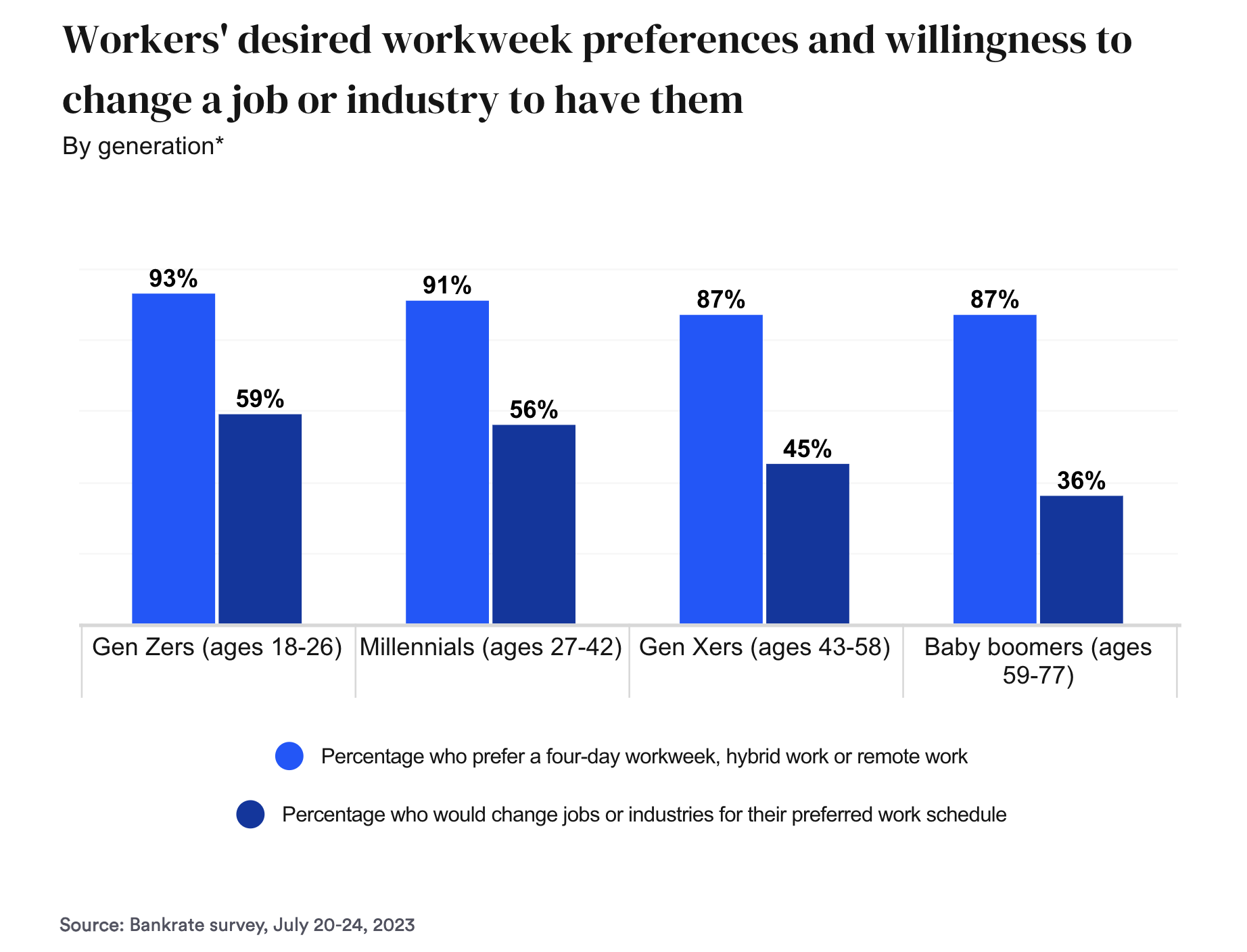
ECONOMY Remote Work Isn't Going Anywhere | | | | We've been monitoring the jobs economy closely these last couple of years, because the concept of work and how it's defined has been undergoing a historical shift since the onset of the pandemic, and maybe even prior. After much debate, and now that the dust has settled, it appears as if the verdict is in — remote work is here to stay. Employees make it clear - The overwhelming majority of Americans either employed full-time or seeking full-time work are in favor of flexible working arrangements. Of the respondents, 89% said that they support four-day work weeks, remote work, and hybrid working arrangements.
- Flexible working arrangements are popular all around, but they're extremely well-received by women and younger employees. 92% of full-time women support at least 1 of the flexible working options compared to 87% of men, and the same spread is seen between Gen Z (93%) and baby boomers (87%).
- What would you give for it? Employees are willing to sacrifice. 78% of full-time workers who support remote work would be willing to give up something for it. Like what? Well, 42% would go so far as to change jobs or industry, 35% would work weird hours, 28% would take a job they're less interested in, and 15% would accept less pay.
What does this mean for employers/employees alike? - For employers, accommodating employees' desire for flexibility becomes key, and it's highly likely that we continue to see a rise in the popularity of flexible work options as a fringe benefit of sorts.
- For companies, increased flexibility and adoption of remote work can lead to increased productivity, profitability, trust between hierarchies, and even elevated company morale overall.
- For employees, having access to remote work means increased flexibility, but also an increase in responsibility. Flexible working arrangements require trust, reliability, prudence, and competence. In order to succeed in this environment, be prepared to stay organized and on top of things.
| | | |
FINANCIAL PLANNING What's The Right Age To Be Financially Independent? | | | | As the years go on, it seems like life is starting later for each generation. As we progress, improve, and ultimately raise the barriers to entry for "real life" as we know it, it's taking us longer and longer to make the leap. The median age of a first-time homebuyer back in 1981 was 29, whereas today it's 33. Having kids and a house by age 25-30 might've been normal 50 years ago, but today that timeline has shifted. More Gen Z and millennials are living at home than ever before, and there are good reasons for that. But how long is too long? Savings.com says that 68% of parents spend an average of $1,400 per month helping their adult children out — where's the cut-off? Tips to navigate adulthood for both parties - Assess the situation: Every family situation is unique, and you'll need to assess the details of your situation to decide if it's justified. If your children are staying at home for prudent reasons, working towards their own success, and facilitating a symbiotic relationship between parties — this should be what you're aiming for, and there's no shame in that.
- Prepare on both sides: As a parent, you're preparing your children for the real world in your own way. And it's more expensive than ever out there, so preparing them for this environment will take a little extra. As an adult living in your parent's home, it's also on you to take responsibility and initiative, eventually putting yourself in a position to go out on your own. The sooner both of these processes begin, the better.
- Do more than before: It takes more to be normal now, and the white-picked fence life has become more like a gold-plated one. As harsh as it is, from an individual standpoint, this means we have to work even harder (and smarter) than before.
- Help your parents out: And if you're staying at home into adulthood, the best thing you can do to make this dynamic work well is to help out as much as you can. Whether it's doing household chores, contributing to the bills, or both, alleviating some of the weight off your parents' shoulders will always be appreciated.
| | | |
🌊 BY THE WAY | - 👨🏻💻 Answer: 39%. Compared to 64% of 21-year-olds back in 1980, just 39% have full-time roles today (Pew Research Center)
- 🧳 Student loan employee benefits are on the rise (Axios)
- 👀 ICYMI. It's tough to obtain a loan right now (Finny)
- ✈️ Southwest Airlines is giving companion passes just for flying roundtrip (Fortune)
- 📚 Finny lesson of the day. With student loan repayments oficially resumed, one of the top considerations for many borrowers is the possibility of consolidation:
| | | |
| |
| Advisory services are offered through Origin Financial, a Registered Investment Adviser registered with the U.S. Securities and Exchange Commission. The status of registration as an Investment Adviser does not imply a certain level of skill or training. The information contained herein should in no way be construed or interpreted as a solicitation to sell or offer to sell advisory services. All content is for information purposes only. It is not intended to provide any tax or legal advice or provide the basis for any financial decisions. Nor, is it intended to be a projection of current or future performance or indication of future results. | | | | | | | |










No comments:
Post a Comment