Welcome to My Blog

New CEO and Chairman for EgyptAir

Tuesday, 20 December 2011

Trip Guide News

0
Captain Hossam Kamal has taken over the position of chairman and CEO of EgyptAir Holding Company.

The announcement follows last week's news that the former chairman of EgyptAir Holding Group and airline CEO Hussein Massoud has been sworn in as the new Egyptian minister of civil aviation.

Kamal takes over the position with more than 29 years of experience within EgyptAir and following his 2009 appointment as EgyptAir Holding vice chairman.

EgyptAir has said that during his tenure as a vice chairman, Kamal achieved a significant level of success; he played a substantial role in many influential projects that actively supported and enhanced EgyptAir’s performance.  


Kamal is known for offering excellent business solutions, the company has said. He was a board member of EgyptAir Holding Company where he played a key role in the EgyptAir expansion plan and businesses modernisation. Moreover, Kamal chaired several strategic committees adopting the quality improvement in all EgyptAir subsidiaries and coordinating with Egyptian airports to bring forth simplifying the operation. He also led the EgyptAir investment plan committee that added positively to the development and cost reduction initiatives. Besides, Kamal headed the branding committee which managed the transition period of EgyptAir to the new brand and upgraded customer service.

Captain Kamal is an active B777 pilot, trainer and examiner with experience exceeding 13,000 flying hours. His subsequent career within the flight operation sector brought him to the position of GM Flight Operations Training in which role he was involved in promoting safety and operational quality.

 Post Courtesy
Email Us at FlightAfricablog@gmail.com
Continue Reading »

TAAG Angola to have daily flights to Brazil until January

Trip Guide News

0
As result of the high demand during this peak season, Angolan Airlines TAAG Angola will increase its frequency to Brazil with two extra flights per week, each for Rio De Janeiro and Sao Paulo. With this increased frequency, TAAG will now be offering daily flights to Brazil until 27th January, 2012.

Image Courtesy aviacaoemnoticia
 Currently, TAAG Services the Rio Route three times a week with departures from Luanda on Tuesday, Thursday and Sunday while the Sao Paulo is serviced four times a week with departures from Luanda on Monday, Wednesday, Friday and Saturday.

Email Us at FlightAfricablog@gmail.com
Continue Reading »

Fly 540: Africa’s low cost flights waiting on the runway

Monday, 19 December 2011

Trip Guide News

0
It’s the “world leader in low cost flights in Africa”. Its website boasts the cheapest flights and the best service on the continent. What’s more, it could be flying towards a joint venture with EasyJet founder Sir Stelios Haji-Ioannou. Only unfortunately some of its flights don’t seem to exist.

This is Fly540, an airline owned by Lonrho, the London-listed company once run by Roland “Tiny” Rowland. It lists on its website a string of destinations across Angola, Kenya and Ghana. Last week it was offering flights from Luanda, the capital city of Angola, to Lubango and Benguela. The services were detailed on Lonrho’s website with flight numbers, departure times and price. Some were listed as available, others sold out.
Sources on the ground said neither was taking off. “They haven’t been running for a month,” a Fly540 employee in Benguela Airport said. “No flights this week,” reported another employee in Lubango Airport. “They may be flying next week. I don’t know.”
The discrepancy between what Fly540 is purporting to offer and its operation comes despite Lonrho announcing “a full roll out of services in Angola” to the London Stock Exchange in July. According to Lonrho executive chairman David Lenigas, a listed-market entrepreneur with 147 directorships to his name, the lack of flights between the two destinations reflects the problems of establishing an airline in Africa.
“The flights exist but the aircraft have not arrived yet,” he said. “Those are the flights that we have been given by the aviation authority. We have two new aircraft arriving in January that will service those routes.”
Problems servicing the routes have come hand in hand with huge losses for Fly540. Although Mr Lenigas said last week that the airline “makes money” the most recent accounts show it sinking deep into the red.

 Operating losses for the six months to the end of September topped £7.9m, up from a loss of £4.8m in the previous year. This has led to some analysts suggesting the company could be sold, which was denied by Mr Lenigas. However, the financial and operational performance of Fly540 has not stopped Lonrho’s aviation ambitions enjoying some success. Earlier this month the potential joint venture with Sir Stelios’s easyGroup attracted huge interest from investors.

Rubicon Diversified Investment, a company in which Lonrho is an investor and which Mr Lenigas and his chief executive Geoffrey White, are directors, revealed plans to launch Fastjet, a new African airline with Sir Stelios. The announcement sent Rubicon’s shares soaring from less than 1p to over 10p, before settling back to end the day at 7p. Good news for Lonrho. Two weeks before the share spike, Lonrho, along with unnamed private investors, agreed to buy 40m shares in Rubicon at 1p.

On Rubicon’s current share price of 4p the investment has quadrupled in value netting a paper profit of around £1.2m. The new-found buoyancy in Rubicon’s shares helped the company raise a further £9m from institutional investors last week, this time at 4p a share.

Mr Lenigas said the money would be used to acquire new aircraft for Fastjet. “Stelios is very excited about the prospects in Africa. No it’s not easy getting things done, but the demographics and the economic growth make it enormously attractive.

“What we have done [with Fly540] is demonstrate that the model works. We are currently operating across the network on an 85pc to 92pc load factor. What this is about is a standardised product operating with on-time departures.”

The next step could be to bring the two airlines, Fastjet and Fly540 together, which Mr Lenigas said “was an option”. Trying to roll out that model across Africa will not be easy. Sir Richard Branson spent three years trying it with Virgin Nigeria.

It cost him millions and he pulled out in 2008.

Post Courtesy: The Telegraph
Email Us at FlightAfricablog@gmail.com
Continue Reading »

Ceiba Intercontinental Joins African Airlines Association(AFRAA)

Trip Guide News

0
The Equatorial Guinea national carrier, Ceiba Intercontinental has become a full member of the African Airlines Association having met the eligibility criteria and filed its documentation with the continental air transport body.

This was announced at the recently concluded 43rd AFRAA AGA in Marrakech, Morocco. As a member, Ceiba Intercontinental will now be able to participate in all the Association‟s projects, programmes and activities and benefit from consultancy, training and expert assistance provided by AFRAA.

Ceiba International
The little known airline from the oil rich Equitorial Guinea recently took delivery its new Boeing 777-200LR (reg 3C-LLS, serial 40668). The airline was founded recently as Equitorial Guinea invests to jump start its aviation industry with the oil boom. The airline also owns and operates two ATR42s and two ATR72s on domestic and west African regional services from Malabo and a single Airbus A300F freighter, wet-leased from MNG Airlines of Turkey, for international charter flights. The airline's website (currently under construction) refers to flights to Central America and, soon, to the Middle East.

The Association currently has an active membership of 32 airlines after it recently purged itself of airlines that were defaulting in their membership obligations or that had stopped operations. 

Additional Sources: AFRAA

Email Us at FlightAfricablog@gmail.com
Continue Reading »

African Airlines Association to hold 44th AGA in Mali

Trip Guide News

0
The African Airlines Association announced at the recently concluded Annual General Assembly in Marrakech Morocco that it will hold its 44th annual general assembly in Bamako Mali from 18-20 November, 2012.

The host airline of the 44th AGA will be Air Mali, whose Chief Executive
Officer, Mr. Abderahmane Berthe, was elected the new President of AFRAA at the just concluded 43rd AGA in Marrakech, Morocco


Email Us at FlightAfricablog@gmail.com
Continue Reading »

Ethiopian Airlines to become the largest Airline in Africa by 2025

Sunday, 18 December 2011

Trip Guide News

0
Ethiopian Airlines is one of the largest and most profitable carriers in Africa. It has 34 aircraft on order, including 10 B787-8s with a network of 56 international destinations and 17 codeshare partners.

It's a Star Alliance member and in 2010 had an operating profit of ETB1.6 billion (USD92 million). Ethiopian has forged a successful path for its expansion plans and has come a long way since its beginnings as a joint venture between the Ethiopian Government and Trans World Airlines.

The carrier has set an ambitious, but realistic, 15-year strategic plan that includes becoming the single largest airline in Africa. It intends to generate revenues of ETB171 billion (USD10 billion) per year, acquire a fleet of 70 aircraft and improve its Skytrax customer service ranking from three to four stars.

If successful, the plan would make Ethiopian Airlines the largest and most profitable carrier in Africa.
Ethiopian Airlines’ 15-year strategic plan

Measure Current Goal
Revenue USD1.6 billion p/a USD10 billion p/a
In service fleet 47 70 “modern” aircraft
SkyTrax Customer service rating 3 4

The largest on-order fleet in Africa, both passenger and freighter

The African launch customer for the B787-8 made its order in 2006 and originally planned to have the aircraft in service by Jun-2010 on the Guangzhou route. However, like many of Boeing’s B787 customers, the Dreamliner delays have left Ethiopian behind on expansion plans. The carrier currently has 36 aircraft on order, the most of any African carrier.

In 2010, Ethiopian placed its largest order to date – 12 A350-900s, due for delivery between 2016 and 2019. The order was designed to give Boeing a wake-up call – implying that its long-time African operator was unhappy with the delays, and that it was prepared to look elsewhere for new aircraft. Despite the apparent threat, Ethiopian Airlines reaffirmed its Boeing order and is expecting its first B787-8 between 12-Mar-2012 and 15-Jun-2014, not Jan-2012 as originally thought. Ethiopian stated the new aircraft, both the B787-8s and the A350-900s, would be used to complement and replace its existing fleet, with the A350s to be deployed on services to the Far East and the Americas, and the B787-8s likely to replace B767s and B757s.

Ethiopian’s freight network supports the country’s trade relations

A strong point in Ethiopian Airlines’ portfolio is its substantial freight operation, with a dedicated cargo fleet of five aircraft and four B777-200LRFs on order. Cargo and freight services accounted for 17% of its total 2010 revenue. The carrier serves more than 40 destinations in its freight network through dedicated freighters and belly space on passenger aircraft.

Ethiopian Airlines’ dedicated freight network
Ethiopia’s largest trade partners are the European Union, China, the US, Saudi Arabia and India. Ethiopian Airlines operates a dedicated cargo network to all those countries bar China and the US, although belly capacity, codeshare partners and sea links enable trade to these countries to remain strong. Ethiopia’s trade with other African countries is relatively weak, with Sudan, Tunisia and South Africa the only countries being a top 20 trading partner.

Ethiopia’s major trade partners: 2010

Ethiopian will give Star Alliance three main bases in Africa

Ethiopian recently joined the Star Alliance, an event that coincided with the B787 Dream Tour of Ethiopia. Ethiopian, mentored by Lufthansa, joined fellow African Star Alliance members South African Airways and EgyptAir, as the alliance extends its coverage to all but the west and centre of the continent. In the lead-up to the approval, Ethiopian Airlines established codeshare agreements with several key Star Alliance members, the latest being Singapore Airlines, and the most important being founding members SAS and Lufthansa.

Ethiopian Airlines’ codeshare partners: 2011
Airline
Since
Region
Dec-2007
Asia Pacific
n/a
Asia Pacific
n/a
West Africa
Mar-2003
Asia Pacific
Jul-2000
Europe
Dec-2009
Europe
Jul-2008
North Africa
n/a
Middle East
n/a
Middle East
n/a
East Africa
Lufthansa
May-1997 F
Europe
n/a
Central Africa
SAS
May-1997 F
Europe
n/a
Middle East
Singapore Airlines
01-Apr-2000
Asia Pacific
South African Airways
Apr-2006
Southern Africa
Apr-2008
Europe
Ethiopian’s entry into Star Alliance means the global airline group will have three main bases in Africa – Addis Ababa, Johannesburg and Cairo. Ethiopian hopes Star Alliance membership will significantly boost Addis Ababa International Airport’s role as a prominent African gateway, boosting revenues, reputation and presence.

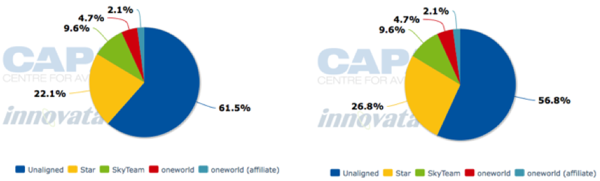
Most seats in Africa are unaligned, Star next best

SkyTeam occupies a relatively strong presence in Africa through Air France-KLM and Kenya Airways. Air France and KLM have each built networks on the continent based around their longstanding colonial linkages. While leading Star member Lufthansa does not have the same historical ties as Air France and KLM, it does have fellow alliance members in the north, south and now the east of the country. Star made a point of recruiting strategic partners that spread across the continent, to complement the more than 50% of Star members that operate to Africa.

Africa seats capacity by alliance (before Ethiopian Airlines’ official joining of Star Alliance): 31-Oct-2011 to 06-Nov-2011
Within Star, EgyptAir provides a most challenging partner for Ethiopian Airlines. Both EgyptAir and Ethiopian serve a handful of destinations in the Asia Pacific including Beijing, Guangzhou, Bangkok and Mumbai, aiming to feed in traffic from the African continent. Star will benefit from Ethiopian’s African network as it is more established than the Egyptian flag carrier, particularly in West Africa, while EgyptAir is much stronger in North Africa. Each carrier serves points in the Middle East – Kuwait, Bahrain, Riyadh, Beirut, Tel Aviv, Jeddah, Sana’a and Muscat – creating considerable overlap in Star’s Middle Eastern network and, again, in their respective goals for feeding beyond traffic from Africa.

Limitations and benefits in Ethiopian’s network

Ethiopian serves many of the mineral-rich African countries, offering valuable additions to Star’s network. These include the Democratic Republic of the Congo (gold and diamonds), Namibia (via codeshare – lead, zinc, diamonds), Botswana (diamonds) and South Africa (iron, oil). Ethiopian also serves fast growing African economies, such as Rwanda, Ghana, Angola, Kenya and Nigeria.

A sub-region missing from Ethiopian’s network is northern Africa, where it offers service only to Cairo – already well covered by EgyptAir. Important gaps in its network include the oil- and iron-rich countries of Libya and Morocco in North Africa, each better covered by EgyptAir – which serves one destination each in Morocco, Tunisia, Algeria and two in Libya – with the natural advantage of serving multiple destinations within Egypt. But together Ethiopian and EgyptAir have Africa covered for Star.

Ethiopian competes with Middle Eastern carriers on air link to China

Ethiopian was the first foreign airline to operate into China more than 30 years ago. At that time a political link, it has proven a valuable and longstanding connection into the Asian powerhouse. Times have changed however; though Ethiopian may have been safe from competition 30 years ago, this is no longer the case and Middle Eastern carriers are rapidly expanding alternative links between the region’s oil- and mineral-rich countries and China. Eight Middle Eastern carriers now operate between China and the Middle East including Emirates, Qatar Airways, Etihad, El Al, Mahan Airlines, Saudi Arabian Airlines, Yemen Airways and Iran Air.
Top 12 carriers operating between the Middle East and China
by seats per week: 31-Oct-2011 to 06-Nov-2011
Only two airlines operate third and fourth freedom services between Eastern Africa and China – Ethiopian Airlines and Air Mauritius – offering approximately 9500 seats per week combined. Emirates, however, offers considerably more than 12,000 seats per week from Dubai to China, with numerous connections on to the Middle Kingdom, which is three times more than Ethiopian’s offering to China. Middle Eastern carriers provide a convenient, one-stop link between multiple points in both Africa and China that rivals the offering of many African carriers, with their multiple stops and limited capacity and frequency.

The Gulf airlines are also achieving major capacity share on routes to Europe. While a similar number of airlines operate Middle East-China and East Africa-China, the importance lies in the number of seats on offer. Emirates, the second largest carrier to operate between Africa and Europe, offers more than 88,000 seats per week, while Air France, the largest carrier to operate between Europe and East Africa, offers just 7,000.

Neighbouring Kenya Airways is a strong competitor

Despite the competition coming from the northeast, Ethiopian Airlines’ most direct source of competition is found closer to home, by way of SkyTeam member Kenya Airways. Kenya’s flag carrier is another leading African carrier with aggressive expansion plans. The airline aims to serve “every African country by 2013” and is making steady progress towards that goal, including a rights issue scheduled for Nov-2011 designed to give the carrier a major cash injection. Kenya Airways’ operating profit surged in FY2011, up 73.9% from a dismal 2010 result, suggesting the carrier is back on track to achieve profitability. Kenya Airways is expected to report its 1H2011 financial results on 03-Nov-2011.

Ethiopian Airlines v Kenya Airways: Nov-2011
Ethiopian Airlines
Kenya Airways
Aircraft in service
47
36
Aircraft on order
36
21
B787-8s on order
10
9
Dedicated cargo aircraft in service
5
0
Dedicated cargo aircraft on order
2
1
African destinations
32
45
International destinations (Africa and beyond)
56
56
Global airline alliance
Expected Star Alliance
SkyTeam
Codeshare partners
17
14

Ethiopian Airlines benefits from government protectionism

One significant factor that contributes to Ethiopian Airlines’ success is its major capacity share at Addis Ababa is due to the Ethiopian Government’s restrictions on foreign airline access. Ethiopian Airlines holds a near-monopoly on domestic routes, where it competes with just one other Ethiopian-registered carrier, Trans Nation Airways, which has one aircraft in service and none on order.

Addis Ababa Bole Airport capacity, seats, per week by carrier: 31-Oct-2011 to 06-Nov-2011
Ethiopia has proven one of the least LCC-friendly markets. Full service carriers account for no less than 99% of capacity at the airport, with flydubai the only LCC to operate into Ethiopia, operating a three-times weekly B737-800 service from Dubai.

Ethiopia capacity share, seats, by carrier type: 31-Oct-2011 to 06-Nov-2011
Protective policies do little to help Addis Ababa’s aspirations to become a large hub, so its future remains inextricably linked to the flag carrier’s growth plans. The result is, paradoxically, to make Ethiopian more exposed to competition from the Gulf carriers’ services into Ethiopia and other African ports. As long as Ethiopian shoulders all of the hub development, so the airport’s attraction limits the flag carrier’s potential to on-carry traffic from other airlines.

Outlook promising but expansion alone is not enough

Ethiopian Airlines has been consistently profitable over the past four years and is likely to see future profitability as its expansion plans are rolled out. Freight, although sensitive to market fluctuations, remains a strong point. Ethiopian has experienced considerable success with its network and sees it as a future revenue generator.

Liberalisation must surely spread across Africa, but Ethiopian – more than almost any other airline in the region – has the opportunity to restructure in time to meet the new challenges this brings. So long as it continues to expand rapidly, this revitalisation process will be made easier – provided it is addressed as a key priority. Expansion alone will not suffice.

Background information
Ethiopian Airlines’ Africa and Middle East route map
EgyptAir’s Africa and Middle East route map

Post courtesy Centre for Asia Pacific Aviation
Email Us at FlightAfricablog@gmail.com
Continue Reading »

Star Alliance reaffirms position as strongest alliance in Africa with Ethiopian and potentially ASKY

Trip Guide News

0
Star Alliance has further cemented its position as the leading alliance in Africa after Ethiopian Airlines officially became a member on 13-Dec-2011. Ethiopian, which has been working on joining Star since being accepted as a new member in Sep-2010, becomes the third African carrier in Star following South African Airways (SAA) and EgyptAir. Ethiopian’s membership significantly boosts Star’s presence on the continent, adding 23 African destinations to the Star Alliance network. Four of the top five African carriers are now aligned, and three of these four are in Star.

Overall the African continent remains largely unaligned. But Star is currently not looking to recruit another African carrier. Instead Star is looking forward to Ethiopian subsidiary ASKY later joining the alliance. Togo-based ASKY would improve Star’s connections in West Africa, the alliance’s weakest region within Africa. Ethiopian gives Star a stronghold in East Africa and Africa overall as Ethiopian has the largest African network among any African carrier, with 40 destinations. Star is already strong in southern Africa, where SAA is based, while EgyptAir is based in North Africa.

With Ethiopian formally joining, Star's share of total capacity in Africa has increased by nearly 5 percentage points, from 22.1% to 26.8%. Star is by far the largest alliance in the region.

SkyTeam now accounts for 9.6% capacity in Africa thanks largely to local member Kenya Airways as well as the African networks of Air France, KLM and Delta Air Lines. oneworld (including oneworld affiliates) has just 6.8% of the total capacity in Africa, making it the least represented of the three global alliances.

oneworld is only represented locally in Africa by Comair, which operates a British Airways franchise in South Africa. Unaligned carriers still account for 56.8% of capacity in Africa, a high figure compared to other regions.

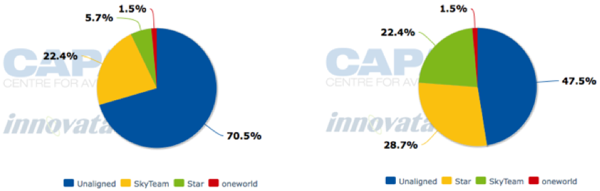
The impact of Ethiopian’s Star membership is biggest in East Africa. Star has now taken over from SkyTeam as the largest alliance in East Africa, increasing its share of capacity from 5.7% to 28.7%. SkyTeam has 22.4% of the capacity in the region followed by oneworld, with only 1.5%.

Africa: The Continent of the Future
Star Alliance CEO Jaan Albrecht said adding Ethiopian represents “a large step forward in completing our Africa strategy”. He said with three big hubs in Africa, Star has succeeded in its task to create an efficient travel system for all of Africa and “bring Africa to the world”.

Star Alliance now has three main bases in Africa - Johannesburg OR Tambo International Airport (through SAA), Cairo International Airport (through EgyptAir) and Addis Ababa Bole Airport (the home of Ethiopian Airlines). The addition of Ethiopian and the Addis Ababa hub means Star carriers now serve Africa with over 750 daily flights to over 110 destinations in 48 countries.

Mr Albrecht says offering a wider choice of flights to, from and within Africa than other alliances is particularly important because Africa is “a region of the world in which air travel is enjoying steady growth rates”. He called Africa “the continent of the future”.

Star Alliance CEO Jaan Albrecht said adding Ethiopian represents “a large step forward in completing our Africa strategy”. He said with three big hubs in Africa, Star has succeeded in its task to create an efficient travel system for all of Africa and “bring Africa to the world”.

Star Alliance now has three main bases in Africa - Johannesburg OR Tambo International Airport (through SAA), Cairo International Airport (through EgyptAir) and Addis Ababa Bole Airport (the home of Ethiopian Airlines). The addition of Ethiopian and the Addis Ababa hub means Star carriers now serve Africa with over 750 daily flights to over 110 destinations in 48 countries.

Mr Albrecht says offering a wider choice of flights to, from and within Africa than other alliances is particularly important because Africa is “a region of the world in which air travel is enjoying steady growth rates”. He called Africa “the continent of the future”.

ASKY likely to join Ethiopian in Star

Speaking to CAPA after the 13-Dec-2011 joining ceremony in Addis Abba, Mr Albrecht says Star does not see a need to add a fourth African member. Instead the alliance’s recruitment efforts are now focused on Russia, India and China. Star is still not represented in Russia or India, two important growth markets. In China Mr Albrecht believes new members beyond Air China and incoming member Shenzhen Airlines would be beneficial.

Mr Albrecht acknowledges Star is still relatively weak in West Africa but believes Ethiopian can fill this void. Ethiopian already serves several destinations in West Africa and has ambitious plans to grow ASKY, a Togo-based subsidiary which launched services at the beginning of last year. According to Innovata data, ASKY already serves 18 destinations, primarily in West Africa.

Mr Albrecht, whose decade-long tenure as Star CEO ends later this week as he has already started a new job as CEO of Austrian Airlines, says the alliance has not yet considered adding ASKY as a member. But as ASKY grows adding Sky would “make sense”.

Otherwise, West Africa lacks suitable candidates that meet Star’s standards. Mr Albrecht says Star was impressed with Ethiopian’s high standards, including its training and maintenance standards, and expects Ethiopian will bring those standards to West Africa with ASKY.

Star to help Ethiopian pursue rapid and profitable growth

Ethiopian Airlines hopes its Star Alliance membership will significantly boost its hub’s role as a prominent African gateway, boosting revenues, reputation and presence.

Speaking at Ethiopian’s joining ceremony, Ethiopian CEO Tewolde Gebremariam said joining Star is an important pillar to its 15-year business plan, known as Vision 2025. He says Star specifically will help Ethiopian implement its cost savings initiative and advance its multi-hub strategy in Africa, paving the way for “fast, profitable and sustainable growth”.

Ethiopian is already one of the world’s fastest growing carriers and plans to pursue further rapid growth, driven partially by its membership in Star, over the next 14 years. Mr Gebremariam says by 2025 Ethiopian plans to generate revenues of USD10 billion, across seven business groups, and carry 18 million passengers. The carrier expects to have 120 aircraft in service by 2025 and a network of 90 international destinations.
Ethiopian currently operates a fleet of 47 aircraft and a passenger network of 62 international destinations, including 40 within Africa. The 47 aircraft include six freighters which are used to operate dedicated freighter service to 24 destinations, including 15 in Africa. Ethiopian plans to continue to pursue rapid growth of its cargo business and is planning an expansion of its cargo terminal in Addis Abba. Ethiopian is also planning to expand its maintenance and training facilities as well as build a new headquarters over the next several years.

Ethiopian needs to order about 60 additional aircraft to meet growth plan

As Ethiopian only has 32 aircraft on firm order (include 12 A350s, 10 787s and eight 737-800s) and plans to replace about 20 of its current aircraft over the next decade, additional orders for approximately 60 aircraft are needed to meet its Vision 2025. As CAPA reported earlier this week, Ethiopian is now looking to exercise several options for 787s. Ethiopian will become Africa’s first 787 operator in 2Q2012 and will use the new type partially to expand its Asian network, where it sees huge opportunity for growth.
See related article: Ethiopian eyes 787 service to Hong Kong and new Asian services as Africa-Asia market booms.

While Ethiopian plans to add several new destinations, particularly in Africa and Asia, it will use Star partners to help expand its offline network. Ethiopian already codeshares with 17 carriers, 10 of which are also in Star – BMI, Brussels Airlines, Lufthansa, SAS, SAA, Turkish, Air China, Asiana, EgyptAir and SIA. Ethiopian plans to expand its codeshare partnerships with several of these carriers as well as implement new codeshares with some of the nearly 20 Star carriers it currently does not codeshare with.

Star increases presence in Ethiopia by over 19 fold

Addis Ababa is now served by only three other Star members - EgyptAir, Lufthansa and Turkish. By joining Star Alliance, Ethiopian has increased Star's capacity share in Ethiopia by over 19 fold, from 4.5% to 88.5%.
The second largest alliance in Ethiopia is now SkyTeam (2.0%) although unaligned carriers make up the country’s second largest capacity share. The SkyTeam alliance is represented by Kenya Airways, who serves Addis Ababa with approximately 2,000 seats per week. oneworld does not have any service to Ethiopia.

Ethiopia total capacity, seats share by alliance: before and after Ethiopian's Star membership
Addis Ababa BoleAirport total capacity, seats share by alliance: before and after Ethiopian's Star membership

Ethiopian Airlines currently operates approximately 115,000 seats per week at Addis Ababa, accounting for 83% of total capacity at the airport. Emirates, the second largest carrier, offers just 7,220 seats per week.
Addis Ababa Bole Airport capacity, seats per week, by carrier: 12-Dec-2011 to 18-Dec-2011
Ethiopia has very low LCC penetration, with just 0.8% of total capacity being held by an LCC (in this case, FlyDubai). Liberalisation has always been a contentious issue across the African continent including in Ethiopia. Ethiopian Airlines, because of its recent financial success and membershiop in Star, is in good position to meet any challenges future liberalisation may bring if the Ethiopian Government is willing to open Ethiopia’s sky to more international operators.

Ethiopian Airlines’ network is a valuable addition to Star Alliance as it serves many of the mineral-rich African countries such as the Democratic Republic of the Congo (gold and diamonds), Botswana (diamonds), South Africa (iron and oil), Namibia (via codeshare- lead, zinc, diamonds) and Angola (oil). It also serves Rwanda, Uganda, Tanzania and Nigeria – some of Africa’s fastest growing economies.

Ethiopian has a dedicated freight network like no other in Africa. Overall Ethiopian's African network is one of the most developed in Africa and is extremely valuable to Star, especially as air traffic on the continent is expected to increase in the years to come.

Its network does however have some limitations. Ethiopian’s coverage of Northern Africa is weak, which, luckily for Star, is already well covered by EgyptAir.

Important destinations missing from Ethiopian’s African network include Libya, Morocco, Tunisia and Algeria. EgyptAir serves all these destinations but has a weaker East and West African network. Therefore the Ethiopian and EgyptAir networks are highly complimentery. There is only small amount of cross-over between Ethiopian Airlines and EgyptAir’s networks, with both carriers serving Dubai, Khartoum, Nairobi, Jeddah, Abu Dhabi and Lagos. Together, Ethiopian Airlines and EgyptAir have Africa covered for Star.

Ethiopian Airlines African route map
Background information
Star Alliance, the largest of the three major alliances, now has 28 members. This will grow to 30 in 2Q2012, when Copa and Avianca-TACA are added as new members. Shenzhen is slated to become Star's 31st member in late 2012.

Global Alliances members
Oneworld
SkyTeam
Star Alliance
American Airlines
British Airways
Cathay Pacific
Finnair
Iberia
Japan Airlines
LAN
Malev Hungarian Airlines
Qantas
Royal Jordanian
S7 Airlines
Aeroflot
Aeromexico
Air Europa
Air France
Alitalia
China Airlines
China Eastern Airlines
China Southern Airlines
CSA Czech Airlines
Delta Air Lines
Kenya Airways
KLM Royal Dutch Airlines
Korean Air
Shanghai Airlines
Tarom
Vietnam Airlines
Adria Airways
Aegean Airlines
Air Canada
Air China
Air New Zealand
ANA
Asiana Airlines
Austrian Airlines
Blue1
bmi
Brussels Airlines
Continental Airlines
Croatia Airlines
EgyptAir
Ethiopian Airlines
LOT Polish Airlines
Lufthansa
Scandinavian Airlines
Singapore Airlines
South African Airways
Spanair
SWISS
TAM Airlines
TAP Portugal
Thai Airways
Turkish Airlines
United Airlines
US Airways
Pending Members
   
Air Berlin
Kingfisher Airlines
Malaysia Airlines
Aerolineas Argentinas
Garuda Indonesia
Middle East Airlines
Saudi Arabian Airlines
Aerolineas Argentinas
Xiamen Airlines
Avianca-TACA
Copa Airlines
Shenzhen Airlines


Article Courtesy: Centre for Asia Pacific Aviation

Email Us at FlightAfricablog@gmail.com
Continue Reading »

Ethiopian to use B787 Dreamliner in the Hong Kong and new Asian services as Africa-Asia market booms

Trip Guide News

0
Article Courtesy: Centre for Asia-Pacific Aviation
Ethiopian will become the first carrier in Africa and Europe to operate 787s when it takes the delivery of its first 787-8 in 2Q2012.

Ethiopian Airlines will further strengthen itself in the nascent but rapidly growing Africa-Asia market by using its new Boeing 787 Dreamliners to open new routes – potentially in China, Malaysia and Singapore – reduce costs and align its overall fleet strategy to better serve existing Asian destinations. The geography of Ethiopian's hub in Addis Ababa allows the carrier to offer as efficient or more efficient connections than those through Middle East hubs. Ethiopian's African network is also unrivaled in the number of destinations served, and the booming times are seeing Ethiopian consider exercising 787 options and accelerating deliveries, slots permitting. Elsewhere in its route network, whose capacity is growing at 30% a year, Ethiopian next year will commence services to Toronto and in 2013 will increase capacity to Washington Dulles by deploying 777-300ERs.

Ethiopian will become the first carrier in Africa and Europe to operate 787s when it takes the delivery of its first 787-8 in 2Q2012.
The 787 last week made its African debut, with a demonstration aircraft in Addis Abba that coincided with a ceremony celebrating Ethiopian joining the Star Alliance.

Ethiopian had planned to first deploy its 787 – most previously expected in Jan-2012 – to Guangzhou, as CAPA reported in Jun-2011. Ethiopian CEO Tewolde Gebremariam told CAPA yesterday that Guangzhou is still an option for the carrier’s first 787 but Ethiopian is also now looking at using its first 787 to serve Hong Kong. He says Ethiopian is also evaluating three potential Asian routes which could be launched with the 787: Chongqing in China, Kuala Lumpur in Malaysia and Singapore.

787 better suited to Hong Kong's lower demand

Guangzhou may not end up receiving Ethiopian's 787 on a regular basis because demand is now so strong from Guangzhou a larger aircraft is needed. Guangzhou had been served daily via Bangkok with 767-300ERs and the intention was to upgrade the route to non-stop once the first 787 was delivered. But Mr Gebremariam said Ethiopian decided to instead upgrade Guangzhou in Oct-2011 to non-stop using the 777-200LR, which seats 321 in two classes. Ethiopian's 767-300ER typically seats 234 while its 787-8 will seat 270 (24 in business and 246 in economy), giving the 777-200LR a 50 seat advantage – as well as greater cargo capacity, critical on the route to Guangzhou, China's manufacturing heartland.

Ethiopian has seen higher demand from mainland China than Hong Kong.
Mr Gebremariam says Guangzhou is switching back this week to the 767 via Bangkok but says demand is generally sufficient to support the 777-200LR. While Guangzhou could still see the 787 instead of the 777-200LR during certain times of the year, Mr Gebremariam foresees the 787 used more regularly to Hong Kong because Ethiopian has seen higher demand from mainland China than Hong Kong.

Ethiopian now serves Hong Kong with four weekly 767-300ER flights via Bangkok. Mr Gebremariam says these will be upgraded to non-stop, likely in 2Q2012, after the first 787 is delivered.
Africa-East Asia routes currently operated or planned
Carrier Destination(s)
Air Austral Bangkok
Air Mauritius Bangalore, Chennai, Hong Kong, Kuala Lumpur, Mumbai, New Delhi, Shanghai, Singapore
Air Zimbabwe Beijing
Cathay Pacific Johannesburg
Ethiopian Beijing, Bangkok, Guangzhou, Hong Kong, Mumbai, New Delhi
Hainan Luanda
Jet Airways Johannesburg
Kenya Airways Bangkok, Guangzhou, Hong Kong, Mumbai
Malaysia Airlines Cape Town, Johannesburg
Singapore Airlines Cape Town, Johannesburg
TAAG Angola Airlines Beijing
Thai Airways Johannesburg
South African Airways Beijing (planned), Hong Kong, Mumbai

Four 787s in 2012 with further orders likely

Mr Gebremariam says Ethiopian is now slated to receive four 787s in 2012 with the first to be delivered in the April to June timeframe. Ethiopian currently has 10 787s on order. All are for the -8 variant with the last aircraft slated for delivery in 2014. Mr. Gebremariam says the carrier is interested in exercising options for additional 787s and accelerating its deliveries, although 787 production slots are tight. Ethiopian, which also has orders for 12 A350s and nine additional 737-800s, needs more aircraft to meet its 15-year business plan.
Mr Gebremariam says the 787 will enable Ethiopian to open new destinations while lowering its operating cost. “It is a pillar of our Vision 2025 [business plan],” he says.

Ethiopian is particularly bullish on using its 787s to expand in Asia although the type will also be used on some European routes, likely starting by the end of 2012. Ethiopian now serves three destinations in mainland China – Guangzhou, Beijing and Hangzhou – and is planning to add several Chinese cities as part of Vision 2025, likely starting with Chongqing. While new destinations in Southeast Asia and North Asia are also part of Vision 2025, China is particularly the focal point as traffic between China and Africa is expected to boom.

Consideration of Asian hub in Singapore

Ethiopian is particularly interested in Singapore. Mr Gebremariam acknowledges that Addis Ababa-Singapore is a small local market but sees potential for Singapore to become Ethiopian's Asian hub. Ethiopian Airlines and Singapore Airlines began a codeshare at the beginning of last month on the Addis Ababa-Dubai-Singapore route (with Ethiopian operating Addis Ababa-Dubai and Singapore operating Dubai-Singapore). This codeshare could potentially be expanded to include Singapore Airlines and SilkAir destinations in Southeast Asia as well as destinations in China, giving Ethiopian offline access to more of Asia.

Singapore Changi is also keen to attract an East African carrier given the opportunities a Singapore-East Asia route could have in developing Singapore as a hub for broader Asia-Africa connections. Currently Changi only has one African carrier, Air Mauritius, and Singapore Airlines only serves one African country, South Africa, non-stop from Singapore (Cairo is served via Dubai). Rival hub Bangkok has been far more successful at developing African connections and has service from several African carriers including Ethiopian and Kenya Airways. While Ethiopian is also considering Kuala Lumpur, Singapore makes more sense as Singapore is a Star hub. Bangkok is also a Star hub but Ethiopian does not yet have a codeshare with Thai Airways.

As CAPA reported in June of expected rapidly growing China-Africa links:
China is a key market for the carrier as Ethiopian is ideally positioned geographically to tap into the fast growing China-Africa market. Ethiopian currently operates 26 weekly flights to four destinations in China, making it the largest carrier between China and Africa. It has already begun codesharing with Star member Air China.
Over the past decade air traffic between Africa and Asia has doubled. Africa supplies China with one-third of its fuel needs as well as notable amounts (by value) of timber, copper and diamonds, with trade between Africa and China surpassing USD100 billion in 2010.

Annual number of inter-continental seats to/from Africa: 1988-2010

Of all traffic measured in revenue passenger kilometres to/from and within Asia-Pacific, Africa will have the highest annual growth rate at 8.4% through 2020, eclipsing the 7.5% of intra-Asia-Pacific traffic and 7.5% of Latin America-Asia-Pacific traffic, Airbus forecast in its 2011 market outlook.
Average annual growth of traffic to, from and within Asia-Pacific: 2011-2020

African travel will also eclipse the global average of traffic growth to/from and within Europe. RPKs from Africa will grow at 4.5% a year between 2011 and 2030, outpacing the 4.2% average, although Africa falls behind the Middle East, Russian Federation and Asia-Pacific.

Average annual growth of traffic to, from and within Europe: 2011-2030

Africa will account for the second-highest growth of traffic to/from and within North America, growing at 5.6% a year from 2011 to 2030.
Average annual growth of traffic to, from and within North America: 2011-2030

While Africa's growth rates are high, the growth is based off currently low figures. Travel to/from/within Africa will be the single smallest region, representing just 3% of 2030's RPKs by Airbus estimates.
Share of world air travel by RPKs: 2030 projection

Addis Ababa hubs provides strategic connections

Ethiopian's hub in Addis Ababa provides geographically convenient connections. On a sample routing from Shanghai to Johannesburg, transiting through Addis Ababa is only 21nm longer than transiting through Dubai.
Route comparison: Shanghai to Johannesburg via Dubai and Addis Ababa

Routing Distance (nm)
Shanghai-Dubai 3488
Dubai-Johannesburg 3450
Total distance via Dubai 6938
Shanghai-Addis Ababa 4773
Addis Abab-Johannesburg 2187
Total distance via Addis Ababa 6960
A routing from Guangzhou to Entebbe (Kampala) is 162nm shorter through Addis than Dubai.
Route comparison: Guangzhou to Entebbe via Dubai and Addis Ababa

Routing Distance (nm)
Guangzhou-Dubai 3152
Dubai-Entebbe 2010
Total distance via Dubai 5162
Guangzhou-Addis Ababa 4345
Addis Abab-Entebbe 655
Total distance via Addis Ababa 5000
While intermediate point connection distances matter (as well as connection flight timing, which Emirates excels at with three departure banks) so too do the destinations served on the other end. Ethiopian serves 40 points in Africa compared to Kenya Airways' 44, Emirates' 21, Qatar's 14 and Etihad's 11. South African Airways, although not as strong a competitor for Asia-Africa services, has flights to 31 destinations in Africa.

Beijing a borderline route for Ethiopian after 787 performance shortfall

Boeing sees the 787 as a vehicle to increase connectivity between China and Africa. Kenya Airways, which is one of four African customers for the 787 (the others are Arik Air and Royal Air Maroc), is also well positioned to tap in the booming China-Africa market.

Boeing sales director for Africa Rob Faye told CAPA following a press briefing yesterday in Addis Abba that the 787 in Africa will be used more for route development than replacing existing aircraft, pointing out that Ethiopian and Kenya are both planning to double their overall fleets over the next 10 years. The 787 demonstrator will be stopping in Kenya later this week as part of its multi-month world tour.

The 787 is geared as a 767 replacement, and Ethiopian's order of 10 787s corresponds to replacements for its 10 767-300s, but its comments to obtain additional frames support route growth. Likewise Kenya Airways has 5 767-300s in service and 9 787s on order.

“Africa is going to grow. Aviation is the catalyst to growth,” Mr Faye says, adding that without connectivity economic growth is limited.

Ethiopian is now unable to use its 767s to serve China non-stop because of the takeoff restrictions at Addis Abba, which has an altitude of over 7000ft. Hangzhou is served via Delhi and is another likely non-stop route for the 787. Ethiopian also previously served Beijing via Delhi but was able to upgrade its daily Beijing service to non-stop in May-2011 after taking delivery of its second batch of 777-200LRs.

Mr. Gebremariam says Ethiopian plans to continue using 777-200LRs on the Addis Abba-Beijing route rather than switch to 787s as he expects the carrier would have some payload limitations with the 787 to Beijing. Mr Gebremariam says Ethiopian would likely have to leave a few seats empty flying the 787 out of Addis Abba for Beijing and would also be restricted in carrying belly cargo.

Boeing, however, claims the 787-8 has the range to reach Beijing from Addis Abba, factoring in Addis Abba’s high altitude and normal 242-seat configuration. Ethiopian plans to operate its 787-8s with 246 seats in two-class configuration.

Even if Beijing ends up being a borderline route for operating the 787-8 with full payload, all of Ethiopian’s other Asian routes and all its European routes are safely within range with full payload. As a result, Mr Gebremariam does not seem to upset with the aircraft coming in with less range than originally expected.
...the range difference between the expected and actual range is very small...
Mr Gebrermariam says the range difference between the expected and actual range is very small with Beijing the only affected current route. He says Korea and Japan are also now out of range but while Korea and Japan are potential routes in the carrier's long-term business plan they are currently not high priorities.

Ethiopian originally intended to use its 787s to serve the US via Europe but later decided to order five 777-200LRs to help offset the impact of the delivery delays on the 787. The first batch of two 777-200LR were delivered at the end of last year and used to upgrade Washington Dulles, which is now served non-stop on the eastbound leg. The last three 777-200LRs from Ethiopian’s order were delivered this year and used to upgrade Beijing and Guangzhou. Ethiopian also uses the 777-200LR on one of its two daily Dubai flights.
Preliminary changes to Ethiopian Airlines long-haul route network
Route Status Equipment Remarks
Chongqing Under consideration 787-8
Europe, general Active
Future
767-300ER
787-8
Guangzhou Active 777-200LR alternating with 767-300ER 787 may replace 767 during select times
Hong Kong Active
Future
767-300ER via Bangkok
787 direct service
Likely first 787 destination
Kuala Lumpur Under consideration 787-8
Singapore Under consideration 787-8
Toronto Future 777-200LR
Washington Dullles Active
Future
777-200LR
777-300ER

Toronto to be launched in 2012

Ethiopian was planning to begin flights this quarter to Toronto with 777-200LRs but postponed the launch of the new route. Mr Gebrermariam says Toronto is now planned to be launched in summer 2012 with two or three weekly 777-200LR flights. Like Washington DC, Toronto will be served non-stop on the eastbound leg but will stop in Rome going west.

Ethiopian is continuing to study other potential new destinations in North America. But for now the carrier plans to focus on Washington Dulles and Toronto. Both are Star Alliance hubs which will help Ethiopian connect with the rest of North America.

Ethiopian does not plan to acquire additional 777-200LRs but Mr Gebrermariam says the carrier has committed to acquiring two 777-300ERs for delivery in 2013. He says the intention is to use the 777-300ERs to up-gauge the Washington Dulles route.

The 777-300ER has the range to be able to operate non-stop from Dulles to Addis Abba. Westbound a fuel stop will still be required but this is no disadvantage to the longer-range 777-200LR, which also needs a stop going west because of Addis Abba’s high altitude. Mr Gebrermariam says Ethiopian will keep its 777-200LRs even as the Dulles route switches over to 777-300ERs as it still has routes which are too thin for 777-300ERs and are too long for the 787.

Overall Ethiopian is a flexible carrier and will likely change multiple times its deployment of aircraft. The main focus is rapid growth and to secure as many modern widebodies as possible.

Mr Gebrermariam laments the 787s are still not coming fast enough, forcing the carrier to stick with some of its ageing 767-300ERs for longer than it wishes. He says Ethiopian this month returned one of its 767-300ERs, which leaves it with 10 of the type. But he said Ethiopian is unable to phase out any of its 767s in 2012 as it aims to continue growing capacity at a clip of 30% per year.

Ethiopian, however, is phasing out three of its seven 757s in 1H2012. Mr Gebrermariam says the 757s will be replaced by a mix of additional 737s, 787s and 767s. Ethiopian is not increasing its 767 fleet but some 767s will be freed up to replace 757s on routes to Europe and within Africa as 787s replace 767s on Asian routes.


Email Us at FlightAfricablog@gmail.com
Continue Reading »

13 Things Your Pilot Won’t Tell You

Saturday, 17 December 2011

Trip Guide News

0
Just found this wonderful post on Reader's Digest, things your pilot will not tell you. Enjoy:

1. “The truth is, we’re exhausted. Our work rules allow us to be on duty 16 hours without a break. That’s many more hours than a truck driver. And unlike a truck driver, who can pull over at the next rest stop, we can’t pull over at the next cloud.” -Captain at a major airline
13 Things Your Pilot Won't Tell You
© Ryan McVay/Photodisc/Thinkstock


13 Things Your Pilot Won't Tell You © Digital Vision/Thinkstock
2. “Some FAA rules don’t make sense to us either. Like the fact that when we’re at 39,000 feet going 400 miles an hour, in a plane that could hit turbulence at any minute, (flight attendants) can walk around and serve hot coffee and Chateaubriand. But when we’re on the ground on a flat piece of asphalt going five to ten miles an hour, they’ve got to be buckled in like they’re at NASCAR.” -Jack Stephan, US Airways captain based in Annapolis, Maryland, who has been flying since 1984


13 Things Your Pilot Won't Tell You © Hemera/Thinkstock
3. “It’s one thing if the pilot puts the seat belt sign on for the passengers. But if he tells the flight attendants to sit down, you’d better listen. That means there’s some serious turbulence ahead.” -John Greaves, airline accident lawyer and former airline captain, Los Angeles


13 Things Your Pilot Won't Tell You © Hemera/Thinkstock
4. “There’s no such thing as a water landing. It’s called crashing into the ocean.” -Pilot, South Carolina


13 Things Your Pilot Won't Tell You © Hemera/Thinkstock
5. People always ask, ‘What’s the scariest thing that’s ever happened to you?’ I tell them it was a van ride from the Los Angeles airport to the hotel, and I’m not kidding.” -Jack Stephan


13 Things Your Pilot Won't Tell You © Hemera/Thinkstock
6. “I’ve been struck by lightning twice. Most pilots have. Airplanes are built to take it. You hear a big boom and see a big flash and that’s it. You’re not going to fall out of the sky.” -Pilot for a regional carrier, Charlotte, North Carolina


13 Things Your Pilot Won't Tell You © iStockphoto/Thinkstock
7. “The smoothest place to sit is often over or near the wing. The bumpiest place to sit is in the back. A plane is like a seesaw. If you’re in the middle, you don’t move as much.” -Patrick Smith


13 Things Your Pilot Won't Tell You © BananaStock/Thinkstock
8. “If you’re a nervous flier, book a morning flight. The heating of the ground later causes bumpier air, and it’s much more likely to thunderstorm in the afternoon.” -Jerry Johnson, pilot, Los Angeles


13 Things Your Pilot Won't Tell You © Hemera/Thinkstock
9. “People don’t understand why they can’t use their cell phones. Well, what can happen is 12 people will decide to call someone just before landing, and I can get a false reading on my instruments saying that we are higher than we really are.” -Jim Tilmon


13 Things Your Pilot Won't Tell You © iStockphoto/Thinkstock
10. “Most people get sick after traveling not because of what they breathe but because of what they touch. Always assume that the tray table and the button to push the seat back have not been wiped down, though we do wipe down the lavatory.” -Patrick Smith


13 Things Your Pilot Won't Tell You © David De Lossy/Valueline/Thinkstock
11. “One of our engines just failed.” What they’ll say instead: “One of our engines is indicating improperly.” (Or more likely, they’ll say nothing, and you’ll never know the difference. Most planes fly fine with one engine down.)


13 Things Your Pilot Won't Tell You © iStockphoto/Thinkstock
12. Well, folks, the visibility out there is zero.” What they’ll say instead: “There’s some fog in the Washington area.”


13 Things Your Pilot Won't Tell You
“We miss the peanuts too.” -US Airways pilot, South Carolina

By Michelle Crouch Courtesy Reader's Digest

Email Us at FlightAfricablog@gmail.com
Continue Reading »

Malta International Airport Timetable: From Malta, Tunis and Tripoli, summer 2011

Friday, 16 December 2011

Trip Guide News

0
Malta, the European Union's smallest member, is a tiny rocky archipelago in the center of the Mediterranean below Sicily. It is actually more southernly than the coast of North Africa, and acts as a European gateway to Libya especially.

Shown here on the Malta International Airport's summer 2011 timetable are weekly services to Tripoli, with an identical flight every day by Libyan Arab Airlines complimented by an array of daily flights from Air Malta, with a twice weekly connection on JAT which goes onward to Belgrade.

Above are four weekly services to Tunis, direct and also via Monastir on Servisair. All these operations increase during the summer months, as seen from the matrix at far right. 

From Timetablist Series
Email Us at FlightAfricablog@gmail.com
Continue Reading »

Qantas Empire Airways: Linking Australia and South Africa, 1952

Trip Guide News

0
For no particular reason, Timetablist has dusted off a series of Qantas articles.

Here is a 1952 postage commemoration, celebrating the first 'regular' linking of two of the Queen's realms, Australia and South Africa. The Qantas Empire Airways Ltd. route from Sydney crosses the antipodean vastness to Perth, then bounds westward over the Indian Ocean, refueling at the Cocos Islands, and later Mauritius, before landing on African soil at Johannesburg. The envelope is cancelled with Mauritian stamps.

From  Timetablist Series
Email Us at FlightAfricablog@gmail.com
Continue Reading »

ASKY Airlines Network, December 2011

Trip Guide News

0
A different ASKY than from a year previous: service to Banjul, Dakar and Pointe-Noire are gone, as is the underlying geography of the Gulf of Guinea. Abuja and Yaounde have been added, with Libreville beginning to seem like a focus city.

Lome-based ASKY seems to have failed at bridging the chessboard of Anglo- and Francophone capitals of West Africa, as one of the only English-speaking link is the familiar Accra-Monrovia-Freetown run, which no longer reaches up the coast to Cap Vert. A weekly flight from Monrovia to Bamako is also now absent.

Timetablist
Email Us at FlightAfricablog@gmail.com
Continue Reading »

Air Mali Network c.2009

Trip Guide News

0
From the Air Mali website, although not up to date. A warm and stately reseau showing Air Mali's network, stretching all the way to Pointe-Noire, off the map at the extreme lower-right. Helpfully, the route lines are color coded by aircraft type, a unique feature which is somewhat cryptically keyed by the "CRJ" and "MD" legend and lower left. Ouagadougou is misspelled. Accra is the only Anglophone city served, via Abidjan.


 Post Courtesy
Email Us at FlightAfricablog@gmail.com
Continue Reading »

New high-loss airline to fly: Hellena Basket Air

Thursday, 15 December 2011

Trip Guide News

0
Time for some humour:

FRESH FROM ITS POTENTIALLY SUCCESSFUL ATTEMPT at destroying the world’s economy, a southern European country is next plotting to bring down the global airline industry. Newly established Hellena Basket Airlines is to offer the world’s lowest air fares from anywhere to everywhere. Advised by very creative financial firm Goldberg Socks and funded by Italian and French banks, underwritten by large German institutions, the heavily subsidised airline will drastically under-price in order to drive its competition bankrupt.

The carrier’s newly leased large widebody aircraft are configured with 40 first-class, 150 business-class and 300 non-taxpayer-class seats for the great majority of locally originating travellers who have never paid taxes. Seating in this section will be fully subsidised by the national government, using borrowed money. However, because the seats are offered at prices well below cost, this will not cost much.

Inflight entertainment systems are to be provided at excessive cost by leading suppliers Bunga Bunga Entertainment. Bunga Bunga will be available in all seats, announced CEO Silva Burlesquepanti, who until recently held an important entertainment and singles events organising position in an emerging-nation government.

Spanish air traffic controllers expressed concern that there was no suggestion of any strike activity at Hellena Basket at this stage, but offered to provide some immediately, in solidarity with any likely future action. “Obviously, by definition, the new airline’s staff will be underpaid and so industrial action becomes necessary at some stage. With our expertise in the area, we are best equipped to ensure they receive the best guidance, prior to our next strike,” said union chief Sr Labour.

Post Courtesy
Email Us at FlightAfricablog@gmail.com
Continue Reading »

EgyptAir Training Centre's new Chief Eyeing African Airlines

Wednesday, 14 December 2011

Trip Guide News

0
With more than 30 years in the industry, Amzy has been a captain on B737, A300 and B767 for the national airline. His last position held was as manager of technical research at EgyptAir.

He said he aims to extend the training business to go further into Africa and cooperate with the African airlines to provide training expertise to the ones in need and utilise the strong relationship between Egypt "and its sister African countries."

Captain Hany Azmy has been appointed vice president for the EgyptAir Training Center and plans to see the organisation reach out to the burgeoning African airlines
Azmy also believes EgyptAir could offer  its training services to other highly growing markets such as India. The Cairo facility is fully equipped with the latest devices for cockpit crew with B777, B737Ng, A320, A340, A330 simulators while cabin crew training is  provided on the CEET and CST trainers.

Post Courtesy 

Email Us at FlightAfricablog@gmail.com
Continue Reading »